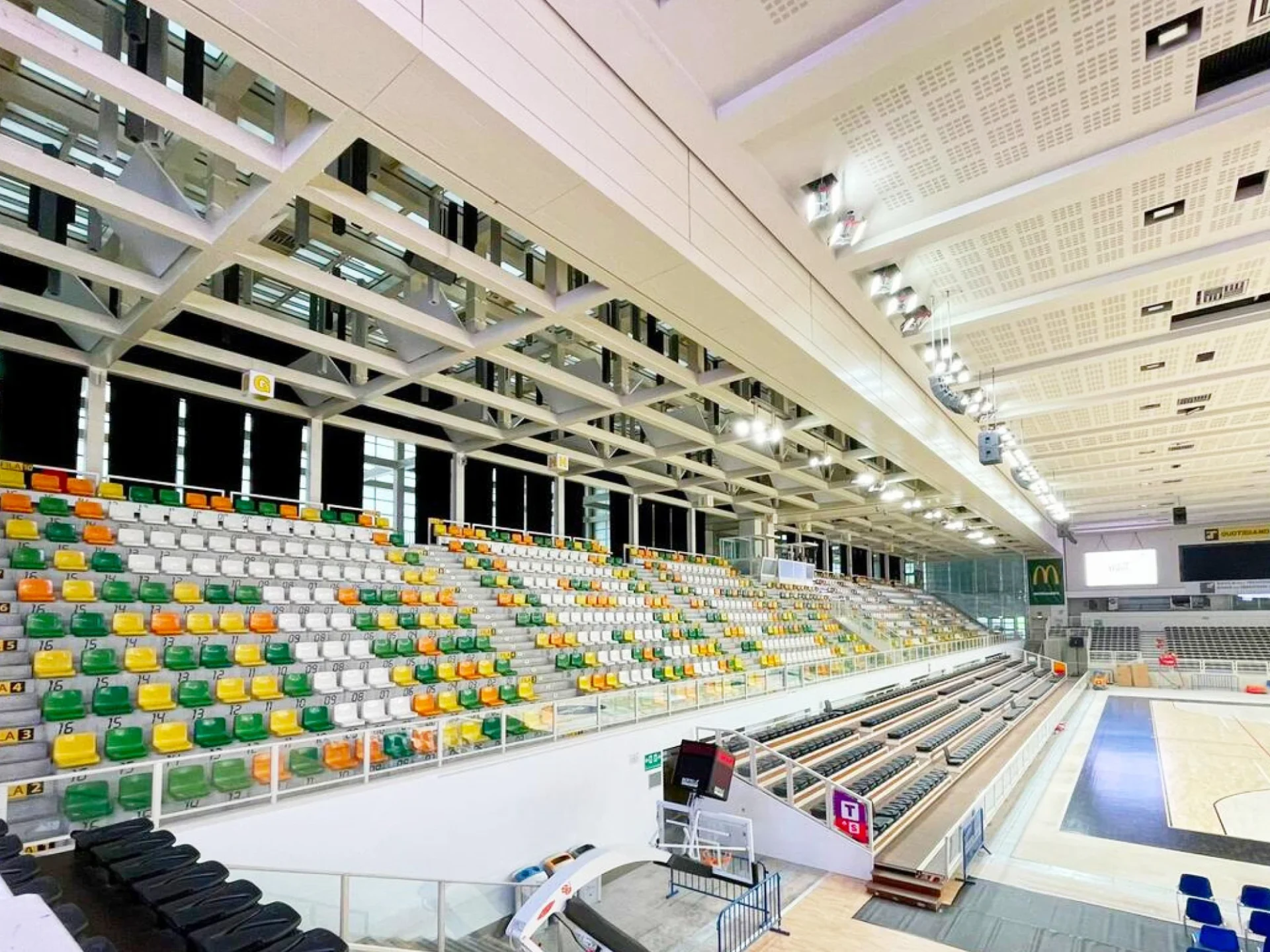
The Trento sports arena, also known as the ‘T Quotidiano Arena’, has undergone a major modernisation project aimed at converting it into a multi-purpose venue for sporting events, concerts and conferences, improving its acoustics, safety and aesthetics.
Within this overall project, Decima oversaw the acoustic upgrade, supplying and installing drapes and sound-absorbing panels.
0
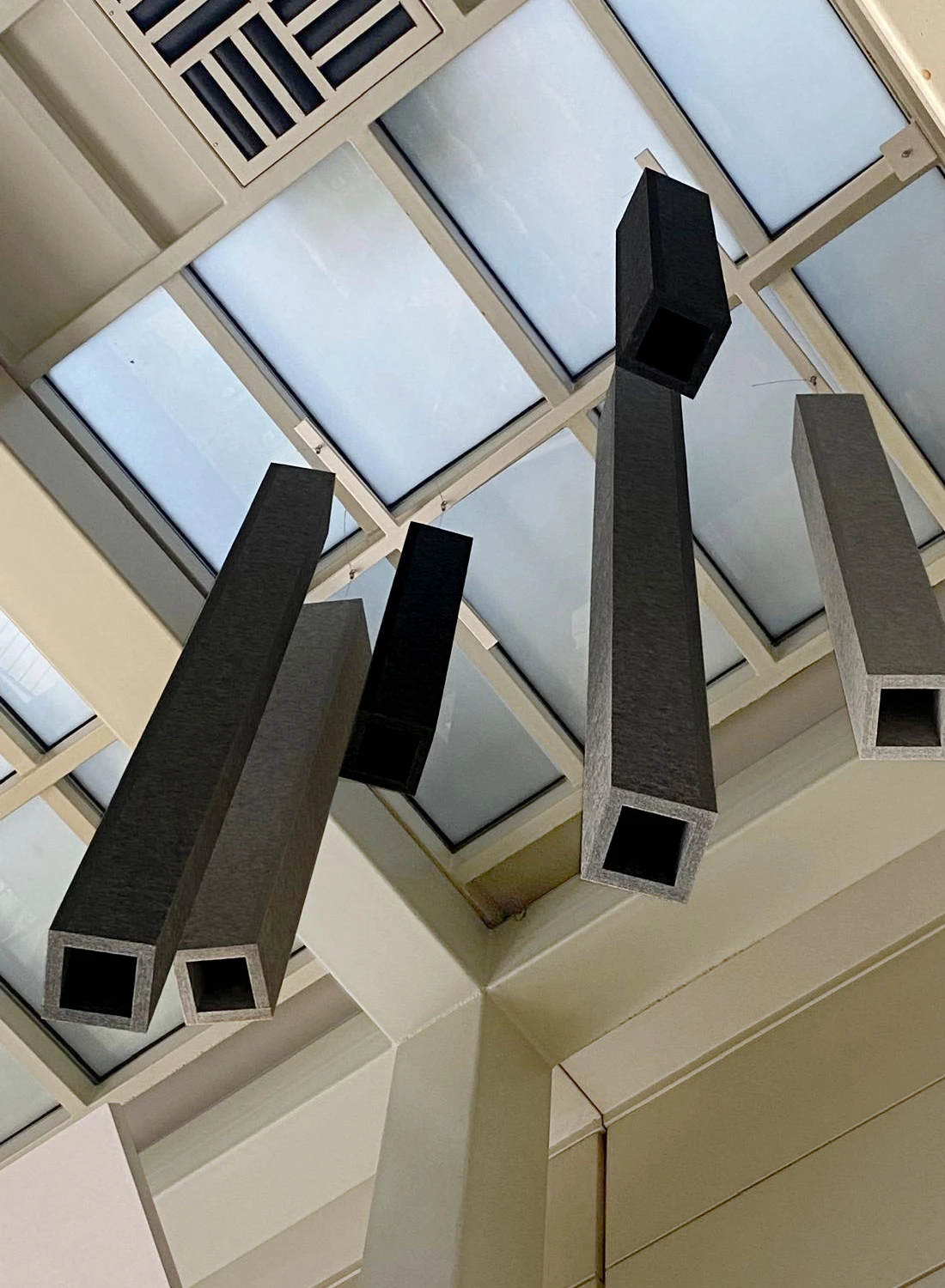
Acoustic rectangular prisms
0
Acoustic ceiling islands
0
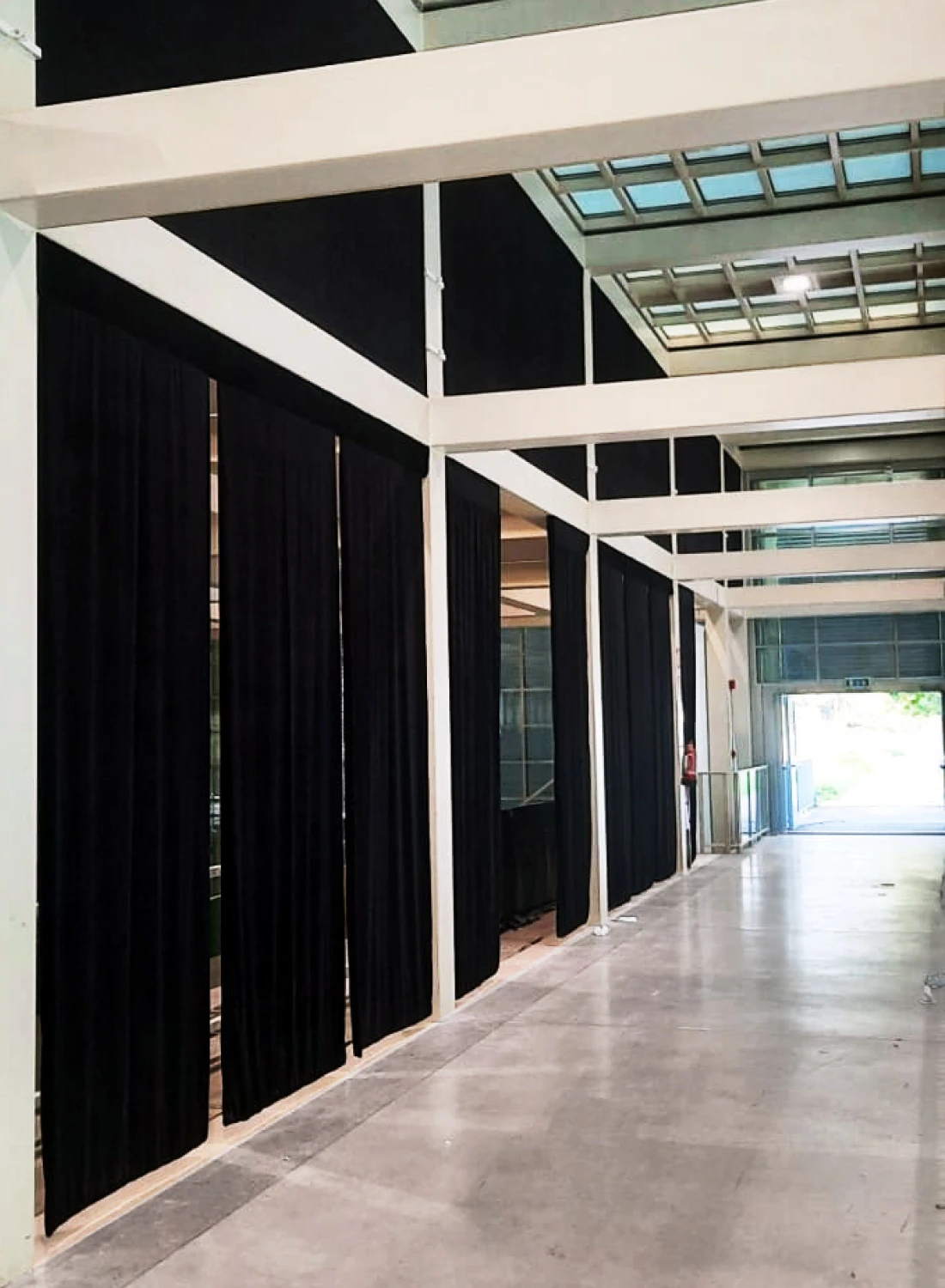
Sound-absorbing drapes
Main characteristics
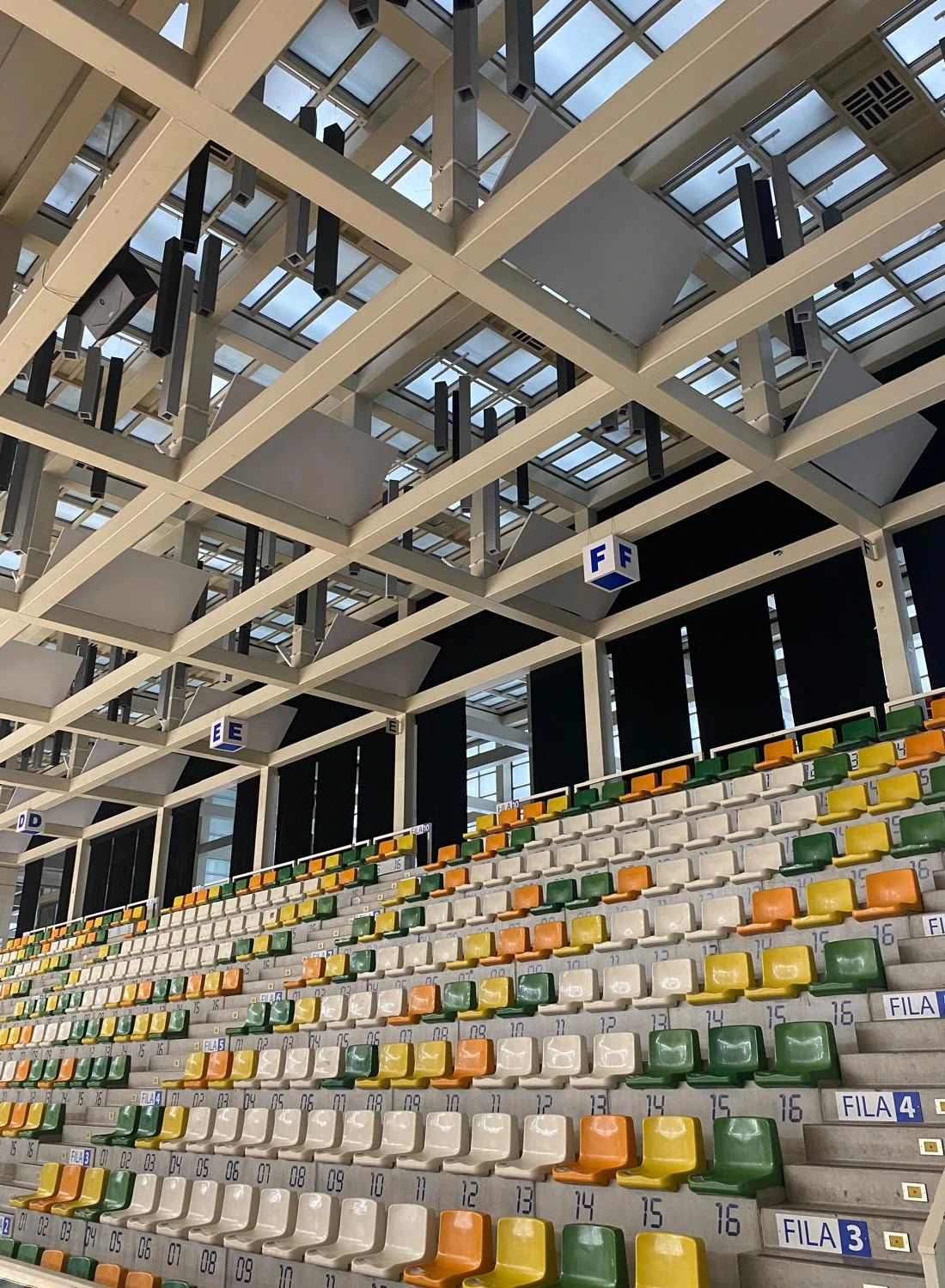
Sound-absorbing drapes: used to acoustically insulate the spaces behind the stands from the sports hall. Made of black double-layer velvet, the taut drapes are attached to rails anchored to the horizontal roof beams using a high-strength Velcro system, which also allows for easy removal for maintenance or washing.
A lead weight is inserted into the bottom edge of each drape to keep it taut at all times. The upper part of the partition, corresponding to the height of the beam, is completed with fixed drapes, made of single-sided velvet, installed taut with a complete Velcro perimeter, without lower ballast. These drapes help to completely enclose the volume and enhance the effectiveness of the acoustic treatment.
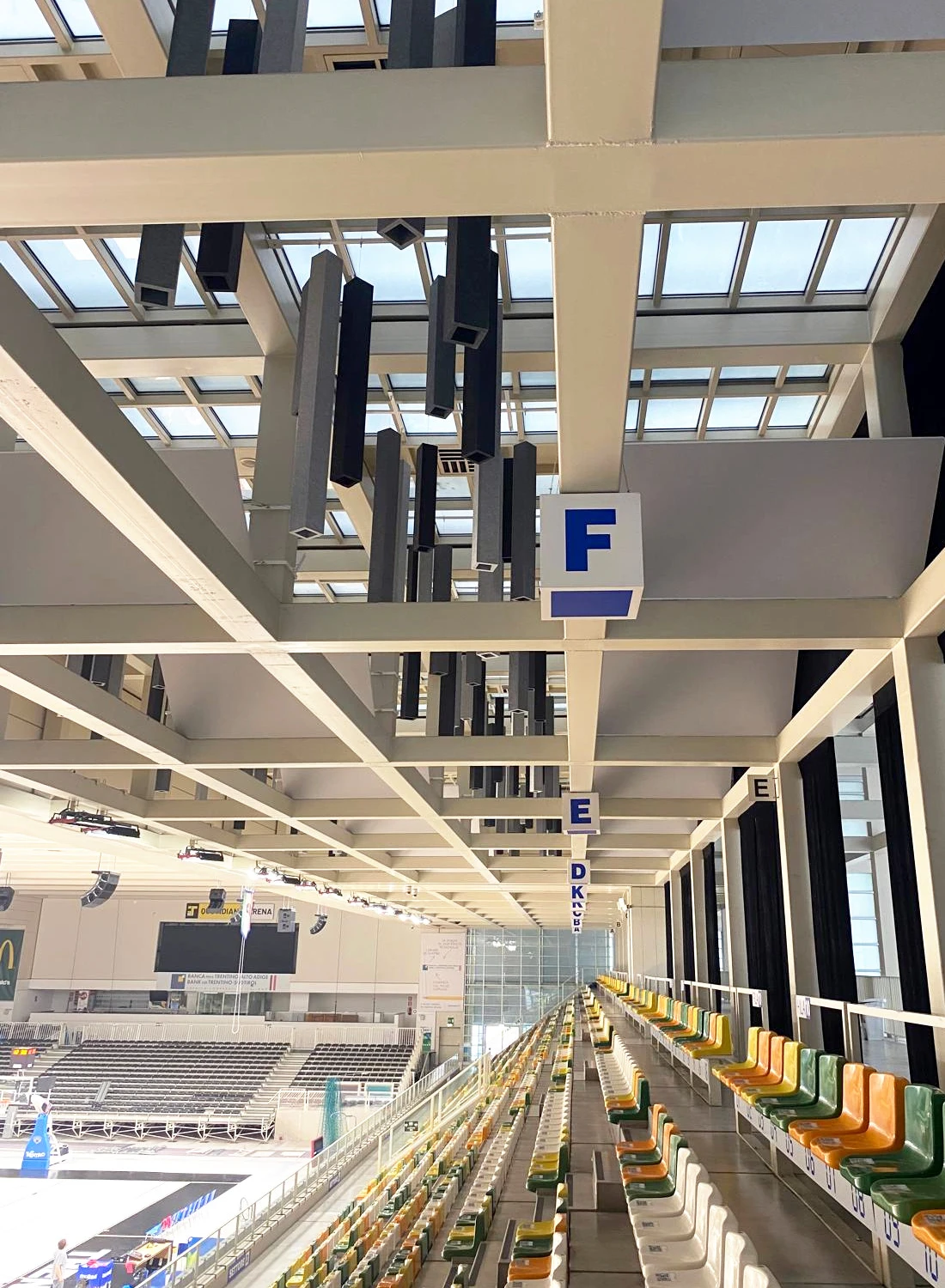
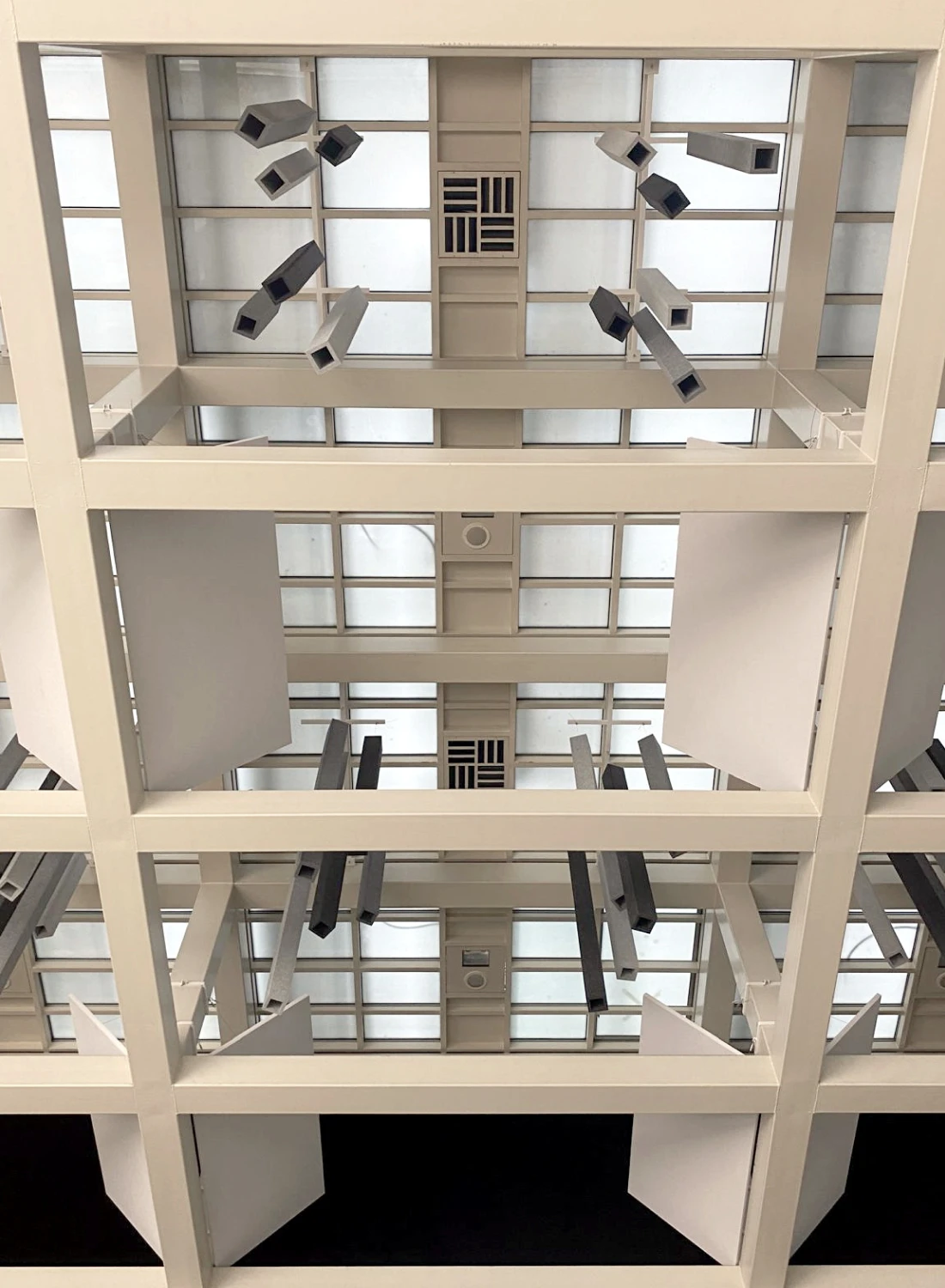
Sound-absorbing acoustic ceiling islands: To enhance the acoustic comfort in public areas, sound-absorbing panels made of rock wool fibre with a smooth, matt, white-painted finish were installed above the stands. Arranged partially supported by the beams, the panels, of various sizes, have been tilted at 45° to deflect and mitigate reverberation in the mid-high frequencies.
Acoustic parallelepipeds: 672 parallelepiped sound-absorbing elements, designed to act as Helmholtz resonators and contribute to the attenuation of low and medium frequencies inside the arena. Installed above the stands, the panels are made of coloured polyester felt and have a square cross-section measuring 150×150 mm, with lengths varying from 100 to 200 cm.
Each element is open at the base to create a resonant cavity and is suspended by means of a special attachment system to the structure. The distribution of the panels has been carefully calibrated based on the equal-loudness contours of the environment, to maximise absorption efficiency in relation to the sound pressure detected in each area.